
Sermon Preached on the Festival of Corpus Christi, 4th June, 2015, at the Eucharist with Benediction of the Blessed Sacrament, Ely Cathedral.
In St Mary’s Cathedral, Edinburgh, there is a most remarkable painting. It’s called ‘The Presence’ and it’s by a little known painter, Alfred Borthwick.
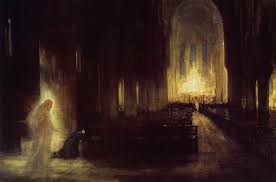
Look it up when you get home. It’s a painting of the inside of St Mary’s Cathedral, viewed from what is probably the West Door, looking down the nave. In the distance, at the East end, communion is being distributed at the high altar. At the back of the cathedral, but in the foreground of the painting, there is a figure kneeling, dressed in black, hunched over, head bowed.
He or she, you cannot tell, is just hidden in the shadows, and keeping well away from the worship. But there at the back, alongside them, stands Christ himself, bathed in radiant light. The scene could be of any cathedral, any church.
Infact, there is a copy of ‘The Presence’ in St Paul’s Cathedral, which Borthwick painted especially for them. The same title, the same story, but just a different building. We could easily re-create the painting here. Imagine if you came into this cathedral tonight; Imagine if you had been brave enough to enter in through the darkness of the Galilee Porch, perhaps thinking that you’re not really good enough, or holy enough to come in, but curious to know what’s going on inside and what kind of service this ‘Corpus Christi’ might be.
Imagine, if you hovered at the back in the shadows, and looked down the nave and observed this scene: The candles, the smoke, the lights, the clergy, the choir, and though it was such beautiful sight, and though it sounded like you were in heaven, you felt as if you were an outsider, you felt as if you didn’t belong, you felt as if you were looking in at a christmas display through a shop window, on a cold december night.

So you slump down at the back, bow your head and close your eyes. You are longing to be near the warmth and the light but your courage fails. And you think to yourself, ‘this Jesus would never invite someone like me to be part of this.’ In the silence, you sense something, and you hear a voice which says: ‘I am with you always to the end of the age’.
The picture we have been painting with our imagination, causes us to wonder where Christ might be this evening. At the back, or the front? Is he at the west door- or at the high altar? The Presence of Christ, we believe, is somehow, through mystery and miracle, to be found in the bread and wine, which are for us, his body and his blood as we share in this eucharist.
And yet, the presence of Christ also reaches and extends to the very back of any cathedral. His real presence extends beyond the sanctuary of any church, it emanates from every altar, it winds its way through every nave, it gathers in its wake, penitents, sinners, doubters, just like you and me, and it carries grace to those places on the edge, the places at the back, the places where people think God will not dare to go.
The real presence of Christ is there on the streets, in the abandoned and neglected, in the tears, the sorrows, the pain, in the humble self-sacrifice offered between one and another, it’s there in the joy which bubbles up in laughter, the love shared between two hearts, the gifts given, the thanks-givings barely spoken by those who have waited for too long, and the sighs too deep for words, exhaled from weary lips.
There have been many well-rehearsed theological debates over the centuries about the real presence of Christ in the sacrament, but whatever we believe, the bread and the wine that we will receive, challenge us with a more pressing question:
Is Christ a real presence within us?
Do we let Christ live in us, breathe in us, and bless us? The Holy Eucharist is often thought of as a personal and private act of devotion, a quiet interior moment of communion with God. It is indeed that place where we find personal, spiritual nourishment and strength.
It is also a sign of something beyond merely ourselves. It is a sign of community, of the body of Christ corporate. It has the power to gather us in, and bind us together, and then send us out from the church, scattering us like grains in the fields, and grapes dispersed on the hillside.
This blessing is not be hoarded for ourselves but shared with the world. ‘Do not hold on to me’, the risen Christ said to Mary, in the garden.
There is a sense of that here. Do not cling, do not hold on to me, let me work in you and through you, let me live in you, and you in me.
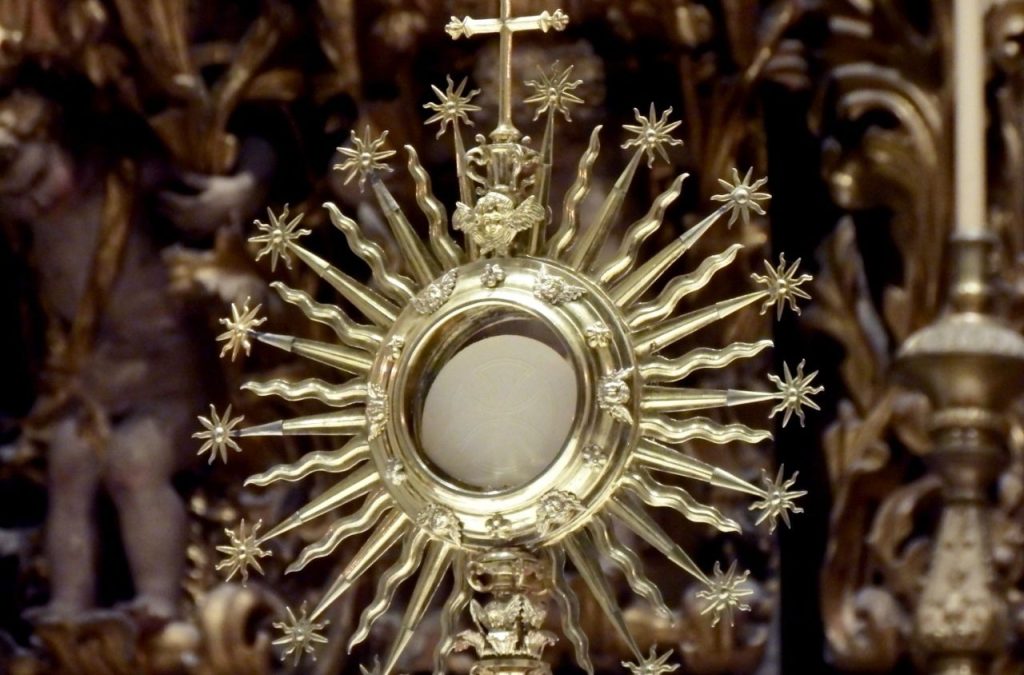
Are we in Christ, blessed, broken, given and shared? At the conclusion of this eucharist, we will be blessed by the sacrament, we bow our heads… the host is held aloft, and we bathe in the presence of Christ.
He shines through us, and beyond us…
Beyond these doors to our city streets,
beyond our expectations,
beyond our judgements, beyond our failings.
His light falls on the righteous and the unrighteous.
Christ is with us, around us, and through this this sacrament we begin to understand that Christ is already ahead of us, already out there calling people, drawing people, to himself.

There should be no-one left at the back looking on, Christ calls everyone to participate, he invites all to sit and eat. It may well be, that as the years roll ever onwards, there will be more and more people standing fearfully at the back of our churches and cathedrals, more people standing in the shadows, at a distance, as if looking on at a christmas display through a shop window on a cold december night.
So what can we do?
On this night the words of the Tantum Ergo are sung as we are blessed by the Body of Christ. They are sung in latin, the language of ancient liturgies, they are words which speak of old practices and new rites, and faith overcoming the failure of the senses. The choir will later sing:
Therefore we, before him bending, This great sacrament revere:
Types and shadows have their ending, For the newer rite is here;
Faith, our outward sense befriending, Makes the inward vision clear.
What can we do? We can bow our heads and we can hold out our hands, and let our senses experience the presence of Christ in bread and wine, the presence of Christ within us, re-constituting, re-membering, re-newing, until we each become part of his blessed body, his feet, his eyes, his hands, with which he blesses the all the world. We can bow our heads again, and pray that when our senses fail, our faith will point us to Christ, where ever he is. Christ at the altar, and Christ at the door, Christ at the front, and at the back. Christ in the heart of his Church, and Christ at the edges and beyond it…..so that by his grace, everyone may be welcomed into his glorious presence.
And maybe, through this old and ancient practice, people may one day see again, that Christ is not far off, but very near. Amen
 On Voice
Leave a comment