
Like a new born, the humble snowdrop peeps out into the world, just as we’re experiencing the last throws of winter. They are like the first heralds of spring. Perhaps the first flower we’ve seen this year.
Something of beauty, so precious, so small, so perfect, and yet steely enough to burst through ice and snow and earth, as hard as iron. Snowdrops, have for long years been bestowed with deeper levels of meaning, beyond their size or significance. For centuries Christian folk in particular have seen in the snowdrop a sign of hope and new life, and also something bitter sweet.
If a snowdrop was brought into the house, (superstitious country folk used to say), death wouldn’t be far behind. Their beauty is fading and fleeting.
When each flower raises it’s head above the earth, there is no fanfare, no great trumpeting of spring….like the loud and confident daffodils -that are getting ready to burst open. No, the snowdrop emerges, somewhat forlorn, bowing her pale head, as heavy as metal, says Ted Hughes in his poem, Snowdrop.
They were once commonly known as “Candlemas Bells”, and in one folk rhyme we are told that “The Snowdrop, in purest white array, First rears her head on Candlemas day.”

It’s thought that they were intentionally planted around churchyards, and at vestry doors, and this simple flower, because of it’s own annual life cycle, has become entwined with the churches festival of Candlemas, and this might explain the meaning that people have ascribed to this perfect, delicate, little flower, which holds within it’s petals a sad farewell and a remarkable re-birth, -a death and a resurrection.
The festival of Candlemas falls almost exactly half way between the winter solstice and spring equinox and liturgically, the festival of Candlemas or the presentation of Christ in the temple, falls 40 days after Christmas, signaling the end of the season of Christmas and Epiphany and the beginning of our turn towards Lent, Passiontide and Easter.
Candlemas often marks a kind of turning away from the nativity of Christ, to consider his suffering and his death and yet, we are also given hope of what is beyond. Our Gospel reading recalls the time when Mary and Joseph took their new born child to the temple, for the ceremonies of ritual purification.
It is there, that they meet the old man Simeon, and the elderly woman Anna, both of whom, nearing the end of their lives, rejoice that they have at last seen God’s messiah.
Simeon and Anna, have been waiting years for this day. It’s as if they have been in stuck, in what seems to them, like an eternal winter. Perhaps they had begun to wonder if God’s promises would actually be fulfilled. And then into the temple comes someone so small, and vulnerable and pure and full of light, that they can hardly believe their eyes.
A child, like a tiny flower, just a few months old. A child who cannot speak for himself, a child who is as powerless, as much as he is a sign of God’s grace. Simeon and Anna rejoice at this gift. Simeon is so overcome the only way he can express himself is through song, and after a lifetime of waiting,
Simeon can at last, face his own mortality and be released into eternal life. His winter is over. Spring has come.
But for a moment his joy turns to sorrow, as he sees a future for this child, which is by no means an easy one. He sees suffering, he sees betrayal, he sees pain, and he sees that this child, almost unbelievably, will cause division, even within households.
No one will be able to hide from the purity that this child will bring, and the inner thoughts of many will be revealed. To Mary, he offers words of forboding: a sword will pierce your own soul too.
Mary, the young mother, would not have been consoled by Simeon’s words in the temple that day. He was warning her of a future grief, before life had even begun.
CS Lewis, in his book A Grief observed, said: ‘don’t come talking to me about the consolations of religion, or I shall suspect that you don’t understand.’
What Simeon saw in this child was no consolation in the way we might imagine. There was no promise in this child of an easy life for anyone, there was no promise that we would be free from sorrow, struggle, and anguish, and yet…
In this child, there was light and life surging through every bone in his body, This child was so full of the spirit, that through him even in the darkest moments, hope would emerge, and love would overcome. And this overwhelming love, would roar into life like a lion.
In another book, C.S.Lewis, made his famous Lion, Aslan, an archetype for Christ. And it is Aslan who breathes new life into a frozen world.
“When Aslan bears his teeth, winter meets its death.
When he shakes his mane, we shall have spring again.” He writes.

Like a searchlight, like a beam of pure light, this child will expose sin, and hatred and injustice, this child will witness against all those who oppress the orphan, the widow, the alien, the hired workers, he will comfort the afflicted and afflict the comfortable.
His breath will turn hearts of stone into hearts of flesh, all desires will be known and no secrets hidden from his gaze. Like a refiners fire, like fullers soap, this child will cleanse and purify and re-create us in his image.
It is no consolation to stand before this child, But we will be transformed, we will all be changed. This child exposes us completely in the light of his presence, in him there is no darkness at all- he comes to expel the dark shadows of evil and make the whole universe brilliant with his eternal light-
So we see, that Candlemas, is like a weaving together of the snowdrop and the lion, a poignant festival in the churches year which causes us to ponder the realities of death and new life. Wrapped within it, we find our own stories of loss and longing and grief.
We yearn for the light to once again dispel the shadows which linger over our world today. And deep down, we each know that we are battling through our own winters and waiting for the spring, we all hope for new life and new beginnings, but often struggle to rise above the frozen earth.
The story of Simeon and Anna, and the story of the Candlemas Bells, might give us all hope that the Sun of righteousness will arise with healing in his wings, to soften the earth and call the flowers from their slumber.
Orthodox Christians call this day the Festival of The Meeting, because of the moment, when Joseph and Mary, and Simeon and Anna, meet in the temple, with the Son of God, the anointed one, the light of the world.
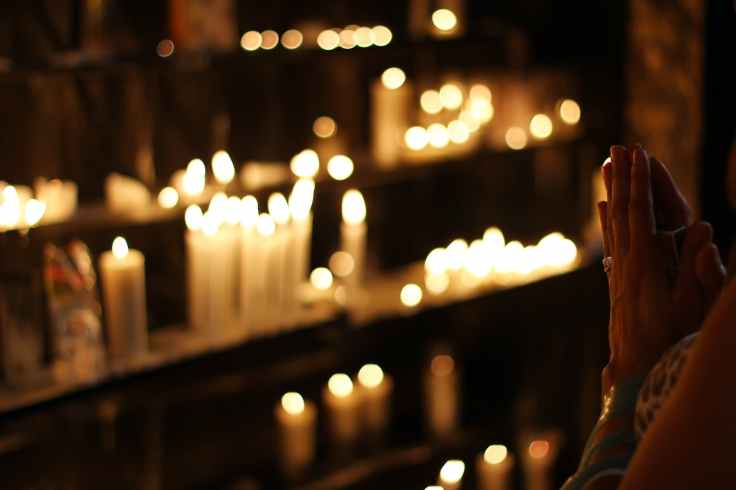
Photo by Rodolfo Clix on Pexels.com
A Chance meeting, orchestrated by the Holy Spirit, a convergence of people in a particular place at a particular time- And perhaps we can see that also met within this festival are many other things which through Christ are brought together. Christmas and Easter, life and death, darkness and light, sorrow and joy, winter and spring, endings and beginnings, the snowdrop and the lion, a sense of waiting and expectation, and the surprise that in Christ, sins will be forgiven and hope will be restored.
Today, at this festival of meeting, we too have been called into the presence of God, and we gather here to meet this child, the light of the world, in bread and wine. Time and eternity meet together in this sacrament. We stand, in this place, before the bright beam of light and love, And we are seen and loved as we truly are, before the light of Christ.
We come here today not only with the light of our candles in procession, but with the whole of our lives, seeking God’s blessing and trusting in God’s promise as Simeon and Anna did, that for every winter we face, we will be given the strength, like the snowdrop, to emerge from the stone cold earth.
And when our hearts are wintry, grieving or in pain, love will come again, like a small white flower, that springeth green.
 On Voice
Leave a comment