
A recent article in the Church Times, advised preachers to avoid sermons about Wonder Woman, a recent cinematic blockbuster. I have to admit, preaching on the Feast day of St Etheldreda, the temptation is certainly there to cast Etheldreda as a holy superhero. Such a response would favour the myth of Etheldreda, over what may have been the very ordinary but Christ-like life of Etheldreda. We all need our superheros I guess, but perhaps a real person can be more inspiring?
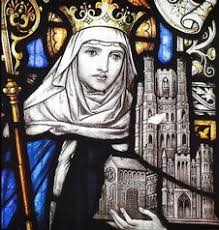
The Venerable Bede, in his history, certainly brings the account of her life down to earth and without glamour. He comments that from the time of her entry into the monastery at Ely she would never wear linen, but only wool (the cheap alternative), and she would seldom take a hot bath except on the eve of great festivals such as Easter, Pentecost and Epiphany -which gives a whole new meaning to the idea of the odour of sanctity…
She rarely had more than one meal a day and remained at prayer from matins until dawn, unless prevented by illness. I can’t help thinking that in comparison to dodging bullets and spinning into boots and a bodice, Etheldreda, Ely’s very own wonder woman, might have been rather boring.
Her life certainly doesn’t sound heroic in the superhero sense of the word, but look more closely and it does perhaps represent the courage and fortitude of a 7th Century Christian in following their vocation and consecrating themselves to the Lord-which in all honesty, should be heroic enough for any of us.
Etheldreda’s story, as we know, begins in plenty and riches- her life could have been very comfortable if only she had persisted with her two arranged marriages and given up on God. She was a Queen, and could have counted on the wealth and status that such a position bestowed on her, she could have worn silk, and bathed daily in scented oils, if her will desired it.
And yet, her mind was set on other things- and with singleness of heart she pursued her calling, renouncing her privilege to build a holy house on an island in the middle of the Fens. A house not made of things of gold, silver, or bronze, a house not made of precious stones, or marble, but a house made of prayer.
This again, may not be heroic, but it does perhaps show us what the Christian virtue of courage looks like. The word courage is derived from the French word for heart. Courage is a condition of the heart enduring in the face of adversity. The Greek philosophers viewed courage as related to valour and bravery on the battlefield and particularly aligned it with military analogies. Fight the good fight and all that.
However, medieval philosophers, such as Thomas Aquinas, re-cast courage or fortitude, as he called it, as a Christian virtue. In contrast to super-heroic physical strength and bravado, courage was about the strength of the soul and the quiet determination of the heart to overcome adversity. This lead the twentieth century writer CS Lewis to suggest that Courage is not simply one of the virtues but the form of every virtue at the testing point.
Courage is, those actions or that attitudes of mind, which embody hope and echo some Christ-likeness, always pointing towards the good particularly in testing situations. -Revealing a way of life that flies in the face of fear and confounds worldly expectations through faith. To put it simply, courage is the virtue which emerges when the going gets tough.
In what we might describe as an extended definition of courage in the letter to the Phillippians, St Paul says, ‘I have suffered the loss of all things, and I regard them as rubbish, in order that I may gain Christ and be found in him’, – words which could so easily be the words of St Etheldreda, who counted her wealth and status as nothing before Christ’s call on her life.
Our gospel reading then follows on from a conversation between Jesus and a rich young man who finds it very difficult to lose anything for the sake of Christ and the promise of eternal life. How hard it will be for a rich person to enter the kingdom of heaven. The more one has, the more painful it is to give it away. Most of us find it very difficult to count our gains as nothing, whatever they may be. Jesus acknowledges, that following him will take courage of mind and heart- The focus of the gospel is money and wealth- but it could be anything to which we cling, anything we cannot give away for the sake of Christ.
In response, something is troubling Peter. The disciples feel they have given up everything to follow Jesus-what more can we give, they ask?
Give of everything and you will be rewarded. Jesus says.
Give of yourself and you will find yourself.
Become as the very least, and through me you will be the greatest.
Etheldreda did give up everything to follow Christ, and for her courage in the persistent, and enduring love of Christ above all else, she takes her place in the communion of Saints.
A moment of courage, in the life of Etheldreda, is painted in the legend, where she stands firm against those who wish to possess her. In the midst of the chase, she turns to face those who pursue her- she looks danger in the eye with true courage. And Lo, her staff then breaks into flower, the floods rise and protect the saint from attack, freeing her to Christ’s service.
Her courage to live in the light of Christ, to suffer with him, to die with him; her courage in forgetting what lay behind and striving to what might lie ahead in the heavenly call of God, provokes a miracle and the sweet fragrance of Etheldreda’s saintliness built this house of prayer, and her example still pervades our common life together 1300 years later.
In the end, Etheldreda stood with courage to be who God called her to be. She had courage to commit her life to the God whom she loved and live out the gospel, and that was no more difficult for Christians in the year 673 than it is today. In the face of adversity, her courage held fast because she knew, she trusted, she had faith- that with God all things were possible. Dare we trust that this is so?
We actually diminish Etheldreda if we imagine she was a medieval wonder woman. We can learn more from her life, as very likely the first English female saint, if we view her as a human being trying to respond to a call from God in the midst of worldly demands and temptations.
Etheldreda’s story might also give us hope in these times of anxiety and uncertainty when we perhaps feel oppressed by fear and hatred and growing discord within our communities, and in the life of our fractious world.
We don’t need imaginary superheroes swooping in, and it is unlikely that any such superhero will appear, but we do perhaps need to find the strength within ourselves to be people of courage for the sake of Jesus Christ.
People who go out into our troubled world in peace, being of good courage and holding fast that which is good. Rendering to no-one evil for evil, strengthening the fainthearted, supporting the weak, helping the afflicted, honouring everyone, People who love and serve the Lord.
May Etheldreda, and all the saints pray for us today, in the name of Christ, to whom be glory and praise and thanksgiving, now and to the ages of ages, Amen.

 On Voice
Leave a comment