It turns out- the answer to life, the universe and everything, might not be 42. It could be 73. Or 67. On the star ship enterprise Mr Scott often said: You canna change the laws of physics, but it seems they are changing all the time. The Hubble Constant, which measures the expansion of the unverse, is apparently not that constant.
Data released this week implies that the universe is getting bigger, quicker- it is expanding- but expanding into what? Is there another space beyond the universe- is this where God lives? Does this new data mean that God is getting further and further away from us? If we build a rocket fast enough- will we ever find Christ waiting for us at the edges of time and space? A current estimate suggests that if such a heavenly hinterland existed at the edge of the universe it would be at least 13.8 billion light years away.
As we celebrate the Ascension, we look naturally to the heavens- and we may well imagine Christ to be up there somewhere in the sky. Perhaps sitting on a cloud or riding on the tail of a comet, God beyond the stars.
Upon entering into orbit on 12th April, 1961, it is alleged that the Cosmonaut Yuri Gagarin, commented ‘I see no God up here’.
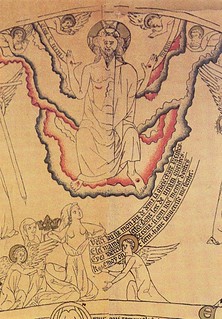
Medieval Christian’s often represented Christ sitting above and beyond his creation. In Hereford Cathedral, The Mappa Mundi, shows the ascended Christ in majesty surveying the whole world, sitting just above and just outside the circumference of the known earth, in orbit if you will, in the space beyond the sky.
History, geography and the destiny of humanity are represented, as understood in Christian Europe in the late 13th and early 14th centuries. However naïve we view that map of the world to be, it proclaimed one simple truth pictorially: Christ was over all things. Christ was the constant.
By the fifteenth century, Leonardo Da Vinci, in his painting Salvator Mundi, depicted Christ holding an orb which represented the heavenly spheres-he was Saviour of the world and Lord of the Cosmos.
William Temple, Archbishop of Canterbury said: The ascension of Christ is his liberation from all restrictions of time and space. It does not represent his removal from the earth, but his constant presence everywhere on earth.
The Ascension defies human logic and science, Christ departs from us physically, so that he may be present with us for all eternity. I am with you always, says the risen Christ to his disciples- until the end of the age.
Why do you stand looking up towards heaven? Ask two men in white robes who appear beside the disciples in Luke’s account of the Ascension in the Acts of the Apostles. This Jesus, who has been taken up from you into heaven, will come, in the same way that you saw him go into heaven. There is a tantalizing clue that this is not the end – that there will be another chapter in the story of salvation. Christ does not leave us as orphans.
The Ascension does not represent Christ disappearing out of our lives- it is an event which weaves together his life, death and resurrection into our earthbound humanity and Christian vocation. The work of God in Christ, was never about creating a heavenly home for himself beyond our reach.
To grasp something of the meaning of the Ascension, we must return to the incarnation -we must hold on to Jesus feet as he rises.
The heavens opened and born of a woman, Christ walked on this earth- God was made flesh. In Christ, heaven touches earth, reaches out to earth- and through his Ascension, Christ takes our full embodied and broken humanity back into the heart of God. In the Mappa Mundi, Christ in Majesty, bears the wounds of the crucifixion in his hands and his side, as does our own Christ in Majesty at the heart of the Octagon lantern in Ely Cathedral.
It is no longer God up above and we down below, but a deifying of all that is human. Christ is the bridge between creator and creatures, between Lord and Servant, between divinity and humanity.
Through his Ascension we come to know that Christ is everywhere -he is in all things, and with all things and over all things, beyond space and time and with us now as close to us as our very breath. Christ reigns at God’s right hand in Glory, the name above every name.
He ascends up into heaven lifting and sanctifying humanity. In the same way, heaven touches earth again through the outpouring of the Holy Spirit to breathe life through the whole creation, and continue the work that has already been begun.
The Holy Spirit comes to enliven the church and re-create Christ’s body, that it may be the means through which the kingdom of God will come on earth, as it is in heaven. The Holy Spirit sustains us in that mission to take one small step for Christ, that all humankind may take a giant leap into God’s love.
From a small group of bewildered men and women, grows a community of transformation and hope. Wherever prayers are said, and praises are offered, and bread and wine shared- wherever peace is proclaimed, and compassion enacted, this kingdom comes a little closer, Christ is present.
Buzz Aldrin, the American astronaut who with Neil Armstrong walked on the moon on 20th July 1969, was very clear that Christ was present with him on the lunar surface.
As he left the lunar module, Aldrin opened a small plastic container of wine and some bread. He had brought them to the moon from Webster Presbyterian church near Houston, where he was an elder. Aldrin had received permission from the church to administer it to himself. He then ate and drank.
Aldrin said
“I poured the wine into the chalice our church had given me. In the one-sixth gravity of the moon the wine curled slowly and gracefully up the side of the cup. It was interesting to think that the very first liquid ever poured on the moon, and the first food eaten there, were communion elements.”
A small symbolic gesture of personal worship and public witness, which extended the bounds of the church, and proclaimed a simple truth:
There is only one answer to life, the universe and everything- Christ, is all in all- and with us to end of the age.
To him be glory and praise, now and for all eternity. Amen.
Can flowers speak? Is there a language of flowers? Flowers have long been used by human beings to communicate with each other without the need for words, to say thank you, to show love, to pay respect, to remember, to offer consolation or bring joy and gladness.
In Victorian society ‘Talking bouquets’ would be sent between sweethearts articulating feelings which couldn’t be made explicitly – according to this little book on the language of flowers– the red rose bud suggested someone was lovely, the daffodil suggested chivalry, the pansy or heartsease meant that someone occupied your thoughts. But there were less romantic flora which could appear in a bunch of flowers-a leek- yes a leek, not surprisingly indicated a frugal nature- and if you included a Xanthium in the bunch- you were telling your beloved they were a little bit pretentious and rude!
In the scriptures, God communicates to the people he loves through nature- flowers and trees speak- they clap their hands- the myrtle and the briar- are a memorial to the Lord – the lily of the field is a sign of contentment and blessing, during Advent we sing of a spotless Rose representing the incarnation of Christ – Christ wears a crown of hawthorn on the cross- at Easter we sing of love, come again like wheat that springeth green. The staff of our own Saint, Etheldreda whom we remember today- burst into flower as a sign of her trust in God.
The flowers are now coming to life and beginning to speak as the earth warms up and the birds begin to sing again. It’s almost as if they have been singing and praying and worshipping, and proclaiming in their own language, and through their own loveliness, the story of the Christian faith. The garden is the place where resurrection happens.
The flowers in their own ministry delight and humble us, they can even provoked us to tears- not because of hay-fever- but by moving heart and soul of those who look upon them.
In every colour of the rainbow, flowers give us all a vision of the kaleidoscope of life- over which the God we believe in delights -as colourful and vibrant as the vision from the book of Revelation, life in all of its fullness before our eyes.
At the beginning of this book- there is an inscription that reads:
There is a language, little known, Lovers claimed it as their own-
but it’s symbols smile upon the land- wrought by God’s almighty hand-
And in their silent beauty speak- of life and joy, to those who seek….
for Love Divine, and sunny hours- in the language of the flowers.
Sweet flowers that perfume all the air, thank God Almighty that made you fair, Alleluia. We give thanks that these flowers have spoken to us of love divine, and the kaleidoscope of life. Thanks be to God.
Voluntary: Tranquillo, ma con moto from Six Short Pieces (Howells), Introit: Salvator Mundi (Howells), Responses: Rose, Psalm: 147, Canticles: The St Paul’s Service, Anthem: Seek him that maketh the seven stars, Voluntary: Flourish for an Occasion (Harris)
Readings: Isaiah 40:21-31, 2 Corinthians 4:1-12
In the name of the Father, Son, Holy Spirit. Amen.
If you’ve even circled on the outskirts of English Choral music you will have come across Herbert Howells. I guess in Jesus College Chapel, I am, as it were ‘preaching to the choir’, in this regard.
It is his music that every chorister wants to sing, every organist wants to play and most people want to listen to. With over twenty settings of the evensong canticles, exquisite anthems, carols, organ preludes, rhapsodies and the much loved hymn tune: Michael….. Howells is a giant of twentieth century Anglican Church music. Whenever we have Howells on the music list at Ely Cathedral, the numbers seem to increase. Could Herbert Howells music be part of our cathedral mission strategy? Why are people still drawn to his music, like moths to the light?
Herbert Norman Howells was born in Gloucestershire in 1892. His father, a plumber, was the organist at the local Baptist church, where the young Herbert would sometimes deputise. He was a child of musical promise. This lead to a move to the nearby Church of England Parish where one can only assume there was a greater musical heritage to tap into. As a chorister and organist, he was schooled in the Anglican Repertoire and tradition.
When he was 16 he became a pupil and organ scholar under Herbert Brewer at Gloucester Cathedral. It was here that Howells met Vaughan Williams, and was enraptured by his Fantasia on a theme of Thomas Tallis. His musical pedigree was enhanced at the Royal College of Music studying under Stanford, Parry and Wood. Whilst at college his output was largely orchestral, and secular, and he was tipped for great things. At the time it was said he had the potential to significantly contribute to the future of British music more than any man of his generation.
A turning point seems to have been when his second piano concerto received bad reviews in 1925. The criticism hurt Howells, damaging his confidence, and resulted in something like a creative block for a number of years.
Much of his early musical promise went into abeyance but he was nevertheless respected as a very fine teacher at the Royal College. Then in 1935 came a tragedy which shaped his life and musical output profoundly.
His nine year old son, Michael, died of polio on a family holiday- Howells found himself paralysed by grief. Stunned into musical silence. What faith he may have had, emptied itself out into nothing.
His young daughter Ursula, encouraged him to write, and channel his grief into music. From this moment there began to emerge like a green shoot from the stone cold earth, a sign of life. Though his music seems to carry death with it- it also carries a yearning for resurrection, a sign of resurrection, a sound of resurrection.
But this is not the sound of resurrection like the Hallelujah Chorus, there is no sound of trumpets raising the dead to life. This is joy restrained.
It is the sound of a resurrection something like the sound of the poignant Easter hymn, Love is come again, like wheat that springeth green. A 15th Century French Carol set in the Dorian Mode.
Similarly, Howells music also sounds the resurrection in a minor key, it is the sound of the resurrection as heard in the Gospel of Mark- which leaves the disciples confused, fearful and full of doubt with no easy answers. It is the sound of a resurrection in which Christ still bears the wounds of the nails in his hands and the spear in his side. It is the sound of a resurrection which speaks of a Father weeping over the lifeless body of his beloved son.
Howell’s association with Cambridge, as Organist of St John’s, brought him back into the world of church music, and his canvas was expanded once again by the aesthetics of Anglicanism, the college chapels and cathedrals. He was captivated by the language of their liturgy, their beauty, their sound world and the purity and power of the human voice. He was encouraged to compose again.
It is said that the most English of all his musical qualities was a remoteness- an ethereal distance. Some said this was due to his looking back to the music of the past and drawing upon tudor composers, like William Byrd and Thomas Tallis. Some think this quality was influenced by the countryside of Gloucestershire- which gave birth to an unfolding beauty, a sense of space and big skies, and a propensity to elevate to mysticism. It has been said that his music appeals to those who prefer incense to sermons -it does not evoke certainty- it does not have the upfront confidence of his mentors, Stanford, Wood and Parry.
Howell’s music is almost translucent- it’s a window into something else, seeking, searching, yearning and longing for something impossible to grasp. But at the same time there is a sensuality, an intimacy and intensity about his music, its’ rises and falls, it’s sinuous, lyrical lines climaxing and fading to nothing.
It would also be naïve to think that a figure like Herbert Howells did not embody many ambiguities within himself, as we all do. As ‘treasure in an earthen vessel’, his marital infidelities were well known, his ego delicate, and what personal faith he may have had was rocked by the death of his son. At the end of his life, in conversation with his daughter, Ursula, he stated that he was certain there was nothing beyond this.
That a self-confessed agnostic could write some of the most transcendent and ethereal 20th Century music in praise of God, is as remarkable as a light shining out of darkness, and as curious as an empty tomb.
Howells music causes the listener to lift up their eyes and wonder, waiting patiently for the Lord who will renew their strength that their spirits may soar with the wings of eagle. His genius is found in works of comparative miniature, creating music for the words of the Gospel that would be sung only in houses of prayer. How well he must have known the songs of Mary and Simeon, how much he must have poured over these texts holding each word up to the light and letting it speak through his carefully crafted notation.
The Hymnus Paradisi can possibly be thought of as his greatest choral work, and for this piece, which is regarded as a memorial to his son, he chose the texts very carefully. Some music was taken from an unfinished Requiem Mass he had been working on prior to Michael’s death, this was complimented with words from Psalm 23, The Lord is my Shepherd and 121, I will lift up mine eyes unto the hills.
The final words of this work, were chosen because Howells himself said, he wanted to end on a note of hopefulness. He was searching for a text which might fit and eventually came upon the following words from the Salisbury Diurnal,
Holy is the True Light, and passing wonderful,
lending radiance to them that endured in the heat
of conflict, from Christ they inherit a home of
unfading splendour, wherein they rejoice with
gladness evermore. Alleluia!
Woven through this and almost every other work, is what we might want to call an essence of mystical Anglicanism, a spacious and generous expression of Christianity where those who seek may find, and those who doubt are welcomed. His music often expresses a holy radiance, a passing wonderful, which does not dazzle, but rather shimmers. For a man who suffered the deepest of griefs, sounding the resurrection was never far from the shadow of the cross. His music responds honestly to God and echoes the fallibility of human existence in the light of Christ.
The music of Herbert Howells sounds a resurrection in which there is a profound and heartfelt sense that sorrow may endure for a night- but joy comes in the morning, like wheat that springeth green.
Everybody has a favorite song, or piece of music. Think for a moment about why a particular piece of music is so important to you. Maybe, hidden within the cadences, melody and harmony of ‘the song in your heart’, there is a memory or reminiscence of something once known and loved. [1] There is something universal about music and when a particular piece of music is heard, we can all remember feelings and emotions associated with it. Perhaps somewhere in the recesses of our memory, particular rhythms, intervals and melodies are familiar, or there is a recognizable theme or motif. In our imaginations we might be taken back to a certain situation or place, and can be re-united for a moment with a certain person or community. Interestingly, throughout history, theologians have often considered music as also being able to appeal to humanities intrinsic religiosity. So, it seems that there may be something more fundamental about the appeal of music to the memory.
Sometimes the memory that music evokes within us, cannot be easily articulated, and is beyond mortal words. We cannot explain it, but we know something about that music seems to move our soul or awaken our senses. Maybe, when we hear the beautiful music of Mozart or Beethoven, there is some deep resonance and reverberation within our very being which cannot be explained or understood, but we know, that when we open our ears and our hearts to that music, we feel like we’re coming home or finding again a deserted sanctuary we once knew well. In music, we are reminded of something sublimely familiar and familial. Using the words of T.S.Elliot, it is as if, through music, we arrive where we started, ‘and know the place for the first time.’[2] Perhaps music, as Saint Augustine said ‘somehow issues forth from the most secret sanctuaries, leaving traces in our very senses or in things sensed by us that if we follow through these traces we can reach without fail those places called sanctuaries.’ [3]
Augustine suggests that music, in some profound way, temporarily unites us with our earliest memories of the music we once heard, in the sanctuary of our creation,[4]and therefore could be considered as an echo of the creative act.[5] Rowan Williams writes, that music reminds us and tells us ‘what we are and what we are not, creatures, not gods, creators only when we remember we are not the creator.’[6] Perhaps through music, we can remember and hear something of the likeness of the sound of God and glimpse something of the sanctity of the creator. [7] Perhaps through music we are able to hear the sound of ‘God with us’, or the sound of the Spirit hovering over the waters, or the sound of the stone being rolled away from the tomb.
Of all the liberal arts, music seems to be unique in this quality. Through music, the human mind can ascend ‘through increasing degrees of abstraction from material to incorporeal contemplation, encouraging the knower towards the vision of God’. [8] In De Musica, Augustine suggests that music moves us towards God, because it articulates order and measure, in a way that ‘imitates’ the perfect ordering and measure of God. Augustine discusses the theory of musical notation including verse, rhythm and meter and considers how these elements combine to modulate time and encourage movement heavenwards. Music, he says, is the ‘science of proper modulations and measurement’; a definition suggesting that there is a tangible link between music and time. Music, as a bearer of metre and rhythm, offers a ‘time-bridging’ glimpse of the unified order of eternity. [9] God’s music, then, could be considered as being utterly perfect in measure and order; in God there is no ‘time’, but only eternity. When music reminds us of God, it is not because God sounds like Vivaldi, William Byrd or George Frederich Handel. It is because we remember something of God’s perfect order and God’s perfect measure when we hear the measure, rhythm and meter of music.
John Donne, the English metaphysical poet, writes that one day we will all once again be brought to that house ‘where there shall be no Cloud nor Sun, no darkness nor dazzling, but one equal light, no noise nor silence, but one equal music, … no ends no beginnings, but one equal eternity’. [10]
God’s music could therefore be thought of as the source of all meter, measure and the progenitor of all earthly music. God’s music is so perfectly ordered that it can bring order out of chaos, it is an ‘equal music’ without meter and measure, beyond ‘time’ and of an equal eternity and perfection. The music audible to human ears has been called God’s ‘greatest gift’ possibly because it helps us remember something of the perfection of our creator.[11] Music is indeed ‘the highest gift of God’ because it reminds us that imprinted in the memory of every human being, there is the capacity to know and remember our creator. [12] There is something within every human soul, which recognizes and remembers through music, the sound of God. [13]
Music and Word- Making memory reality
But the Christian faith is not just about ‘memory’. The Christian faith is about doing something ‘in memory of’, and then living out memory into reality. Music alone, does not unite us with God, and music alone is not able to create or re-create God’s reality. Music might provoke our memory of God, but it will not bring us into the reality of Gods’ presence. The hermeneutical key to understanding the relationship between music, memory and time can only be found in that event which united heavenly eternity with earthly temporality, and remembrance with reality. It is only in the life, death and resurrection of Christ that there can be a new song of creation, a living realization of memory and a new ordering of time.
Our encounter with God through music will only ever be a divine deja vous experience, unless that music is heard in relationship to Christ. Only then can it be become a present reality. Only the encounter with Christ as Word and Sacrament, can anchor the mystery of music into the reality of the present.[14] Through music alone, the human mind can witness to the mystery and invisible reality of God, but music must be combined with context and Christian community, in order that this mystery and invisible reality be made visibly present, in the lives of the faithful. Music raises our eyes and ears to God, but God is only present with us in the reality of Christ. Through Scripture, Sacrament and within the liturgies of the church, these aural memories and auditory reminiscences can be united and transformed into the reality of Christ. It is only through Christ, that God’s music can become our time, and only Christ can turn our memory of God into a reality. Augustine wrote in his Confessions, of the combined effect of Word and Music when he sang hymns during worship, ‘How did I weep, in Thy Hymns and Canticles, touched to the quick by the voices of Thy sweet-attuned Church! The voices flowed into mine ears and the Truth distilled into my heart’. [15] Augustine reminds us that to be united with God, music must be experienced within the life of the worshipping church and must therefore be shaped by Christ’s ordering of time.
Christ’s ordering of time
Maxwell Johnson in his introduction to ‘Between Memory and Hope’ describes the Liturgical year as the space in which we can remember, encounter and await God’s presence among us. [16] Through the church’s celebration of feasts, keeping of fasts, and through the seasons of prayer, penitence and praise, there is a remolding and reshaping of time. The world is measured and ordered in relation to God and thereby experiences the convergence and simultaneous refraction of time, allowing humanity to stand at the interface of eternity and temporality. Liturgical time, like musical time, somehow reflects both the order and the ‘unfolding of God’s grace, of God’s gift of God’s self in and through creation and our being created’. [17] There is something about the liturgical act, which allows us to simultaneously experience past, present and future, and causes time itself to be modulated. Music, like liturgy seems to modulate time, but music is always beholden to the liturgical outworking of Christ’s time. Music is the handmaiden of the liturgy, and exists to glorify God by itself being ordered according to God’s perfect Word, and God’s time for the Church. Whether the Christian experiences, articulates and celebrates time musically, or liturgically, this experience must always be subject to the timing of that divine interruption, when God became man and dwelt among us. Music and liturgy are tuned and ordered by Christ. [18]
It is in the coming of Christ, that we can proclaim that ‘God is with us’ and it is in the reality and remembrance of his death and resurrection that we can today shout ‘He is risen’. This is the music of the church and this is the song the Christian continues to sing, until that time when we meet God face to face, and can sing with angels and archangels and all the company of heaven, in praise of the One Holy Lord.
Because God lived as a man in human history and time, God’s presence among us became a reality. Through the gift of the incarnation, we can order and pattern our lives, to the order and pattern of God, in the person of Jesus Christ. To be a Christian, is to rethink time in relation to our ‘Emmanuel’ and realize that our human concept of time is turned upside down in the crucifixion and re-made anew in the resurrection. As the passion of Christ is the time from which salvation history is measured, so the celebration of Pascha is that time in the liturgical year from which all other expressions of liturgical time come. Through Christ, our time becomes framed by God’s time. Through Christ we can remember the God of past history, we can experience the God of present reality, and we can hope for the God of future eschatology. Because we are recipients of God’s gift of himself in creation, we can live within God’s ordering of time. Therefore, our most profound response to God is a form of music and worship, which is in dialogue with God’s ordering of time.
Dialoging with God’s time: J.S.Bach and the liturgical year
There are many great musicians who write ‘religious’ music, but J.S.Bach has come particularly close to articulating this dialogical relationship between music, the liturgical year and God’s ordering of time. Of all Bach’s gifts to the church, his most profound is the cycle of Cantata’s, which were composed to accompany the ecclesiastical and liturgical year. He provided a cantata for every Sunday and feast day of the ecclesiastical year, and complimented this pattern with music for the Passion, music for the Mass and oratorios for Christmas. [19] This self-appointed task required no less than sixty cantatas a year, over nearly four annual liturgical cycles. Bach’s aim was to establish a proper church music and commented that ‘it was my intention to advance the music in the divine service toward its very end and purpose, a regulated church music in honor of God.’ [20] It seems that Bach, was trying to provide a regulated and measured breadth of music to reflect the measurement of liturgical time in the Lutheran Calendar.
What is interesting about Bach’s music, is that it simultaneously preaches the transcendent and the imminent God. [21] The near-perfect order and precision of the music is fused with scripturally influenced poetry and prose, in a way that balances, both the mystery and reality of God. In addition, each Cantata is sewn into the fabric of the liturgical year and is therefore always responding to the Word of God found in the assigned Scripture readings of the lectionary and in the Churches celebration of liturgical seasons. The form of the Cantata supplied the principal musical piece in the liturgy of the main service, and as such it highlighted a passage from the biblical lesson and then presented a musical exegesis. For Bach, the Word of God became an event in the ‘here and now’ during which God was made manifest in present reality. Bach’s music is influenced by a Lutheran tradition where Christian faith was celebrated in the church and it’s liturgies.[22] Only in the worship of the gathered Christian community could Christ become truly present. Bach could see the relationship between liturgy and time and he wanted his music to reflect that relationship. He instinctively seemed to grasp that God could be found within music, beauty and order, but this music and order had to be tempered by the reality of Christ found in a gathered worshipping community. Through his music, Bach could ‘remember’ and articulate the sound of God, but his genius was that he chose to unite this music to God’s ordering of time in the liturgical year and locate it within the reality of God’s time found in the incarnation. Thus, Bach strove to mirror both the dogma and the mystery of religious experience in musical allegory. Bach’s Cantata’s could be considered as an example of the musical articulation of liturgical time and the most profound combination of music and word ever to speak of the reality of God in Christ, within the context of the faithful community. If the liturgical year is a way of humanity appropriating the Gospel and living in God’s time, Bach shows us that music is a means through which this appropriation can occur.
Bach’s most notable wrestling with the concepts of time and eternity is evidenced in Cantata ‘Gottes Zeit ist die allerbeste Zeit’ BWV106, which is considered one of his most profound pieces. However, Cantata 106 was not written for the liturgical calendar but was written for a funeral, the liturgical commemoration of humanities ultimate temporality.[23] The text reads: ‘God’s own time is the very best of times. In him living, moving, we exist, as long as he wills. In him shall we die at the right time, when he wills.’
In this Cantata, Bach himself grapples both theologically and musically, with the reality of the temporal and the eternal. In death we are both sorrowful as our human temporality draws to a close, but joyful as an eternal life with God begins. This music can be seen as a paradoxical metaphor for Bach’s whole life work, in that it laments and celebrates God’s ordering of time.
Listening to Live –participation and witness through music
In today’s church we are unlikely to hear a cantata every week, but music is still a vital part of almost all liturgies. Whether it is found in the soaring melodies of canticles sung at choral evensong, the polyphony of Palestrina’s music of the mass, or the praise and worship songs of modern congregations; music helps us to remember God and simultaneously be part of God’s reality. On Christmas Eve, when we gather together to sing the hymns ‘O little Town of Bethlehem’ or ‘Silent Night’, the music and the words take us right back to Bethlehem and we become witnesses with Joseph and Mary with the Shepherds, sheep and oxen, to the wondrous gift given by a God of Love. At the same time this music, these words, speak to us in the present and orient us towards a new way of witnessing the world in which we live. On Good Friday we might sing ‘O Sacred Head Surrounded’ or listen to Crux Fidelis and we are then taken back to witness and partake in the sufferings of Christ on the cross. Our song becomes a lament as we walk with Christ to Calvary and we are reminded of human suffering and sacrifice, we feel again the pain of our own sorrows and sadness and offer them to God as Christ offered himself. The power of music in the liturgy is that it moves us beyond merely ‘remembering’ and towards participation. Joseph Geleneau writes that ‘in the celebration of the Church’s worship the point at issue is not music-making but entry by means of music into the salvific mystery.’ [24]
Although music is merely an echo of God’s perfected measure and order it can indeed help our soul ‘remember’ God. But when we hear music in worship and when that music is tuned by Christ and experienced within the liturgy of his Church, we can hear the sound of God rhythmically walking in the Garden, or breathing life into Adam, or singing hymns and psalms as he broke bread for the disciples. And because we have heard and not just remembered, we can begin to live as witnesses to that reality. Augustine proclaims ‘a new song let us sing, not with the tongue, but with the life.’ [25] When musical time is combined with liturgical time we can more truly know God through his Son, Jesus Christ and we can begin to embody a life lived in remembrance and not just a life remembered.
Through music, we can find God within our memory, and we can begin to remember the song present in our human hearts from the beginning of creation. But it is only through Christ that the song in our heart can be sung in unison with the whole of creation, as an expression of a present reality, an articulation of our future hope and most importantly as a hymn to God’s grace.
Bibliography
Augustine, De Musica
Augustine, Confessions
Karl Barth, Church Dogmatics 3/3 (1968)
Jeremy Begbie in Theology Music and Time, (2000)
John Donne, XXVI Sermons (London, 1660), x, 29 Feb 1627/8.
Joseph Gelineau, trans Clifford Howell, Voices and instruments in Christian Worship: Principles, Laws, Applications, (1964)
Maxwell Johnson in Between Memory and Hope (2000)
Robin A.Leaver, J.S.Bach as Preacher: His passions and music in worship (1978)
Catherine Pickstock, Music, Soul, City and Cosmos after Augustine in Radical Orthodoxy (1999)
Wolfhart Pannenberg, Systematic Theology, vol I trs. G.Bromiley (1991)
Leo Schrade, “Bach: The Conflict Between the Sacred and the Secular,” Journal of the History of Ideas (1946; New York: Merlin Press, n.d.)
Gunther Stiller, Johann Sebastian Bach, and liturgical life in Leipzig (1970)
Graham Ward, Cities of God (2000)
Rowan Williams, Keeping Time, in Open to Judgement: Sermons and addresses (1994)
[1] Rogers and Hart seemed to have articulated this mystery rather well in the following lyrics: ‘With a song in my heart I behold your adorable face, just a song at the start, but it soon is a hymn to your grace. When the music swells I’m touching your hand, it tells that me you’re standing near and at the sound of your voice, heaven opens its portals to me. Can I help but rejoice, that a song such as ours came to be? But I always knew I would live life through, with a song in my heart for you.’
[4] Psalm 139:15-16 My frame was not hidden from you when I was made in the secret place. When I was woven together in the depths of the earth, your eyes saw my unformed body. All the days ordained for me were written in your book before one of them came to be.
[5] Mozart ‘did not produce merely his own music, but that of creation’, Karl Barth, Church Dogmatics 3/3 (1968) p298
[6] Rowan Williams, Keeping Time, in Open to Judgement: Sermons and addresses (1994), 249
[7] Compare Ezekiel 1:28 ‘This was the appearance of the likeness of the glory of the Lord.’ Might there be an Aural equivalent?
[8] Catherine Pickstock, Music, Soul, City and Cosmos after Augustine in Radical Orthodoxy (1999)
[13] ‘it is clear that the primary theological value of music is not in what it might offer in terms of embodying good temporal order, but in it’s capacity to empower the mind, despite is agonizing distention, to apprehend the unified order of eternity’ Jeremy Begbie in Theology Music and Time, (2000) p84
[14] Dietrich Bonhoeffer makes the same point in Life Together: All devotion, all attention should be concentrated upon the Word in the hymn. [W]e do not hum a melody; we sing words of praise to God, words of thanks- giving, confession and prayer. Thus the music is completely the servant of the Word.
But lives in me while I do rest)’ George Herbert, Aaron
[19] For example, St.John and St.Matthew Passion, the Christmas Oratorio
[20] Leo Schrade, “Bach: The Conflict Between the Sacred and the Secular,” Journal of the History of Ideas (1946; New York: Merlin Press, n.d.) 9-10
[21] Robin A.Leaver, J.S.Bach as Preacher: His passions and music in worship (1978)
[22] Gunther Stiller, Johann Sebastian Bach, and liturgical life in Leipzig (1970) p206
[23] The reason for this profundity could be located in the text and context of the piece. The Cantata, was thought to have been written for the occasion of a funeral, probably of Bach’s uncle.
[24] Joseph Gelineau, trans Clifford Howell, Voices and instruments in Christian Worship: Principles, Laws, Applications, (1964), 10.
Handel’s Messiah, has followed me around all my life- and it continues to do so- I’ve sung it, conducted it, listened to it, raised money from it, flash-mobbed it, it’s almost like a musical bible to me. I can’t read some parts of scripture without this music filling my brain.
I like it even more these days, an English Oratorio, First performed in Dublin, Written by a German Imigrant who was an expert in Italian Opera, with a Libretto by an Anglican, non-juror using the words of Hebrew scripture and the life of a first century palestinian as inspiration. Like so many of our English traditions it’s not really that English at all. Handel’s Messiah is not just European, it represents what it means to be a citizen of the world as well as a citizen of the Kingdom.
It was first premiered during the Easter season in 1742 in Dublin with the Choirs of St Patrick’s and Christ Church Cathedrals and a small orchestra. It was a charity concert, for the benefit of prisoners’ debt relief, the Mercer’s Hospital, and the Charitable Infirmary. 700 people attended the premiere, women were asked to remove the hoops in their skirts, and gentlemen their swords so everyone could fit in the Great Hall. Though lauded in Dublin, Messiah was initially not so well received in London and after some revision and a gap in its performance history it began to gain traction through annual charity concerts in aid of the Foundling Hospital -it has been a vehicle for generosity ever since and that is another reason I love it.
Written in about three weeks, it is said that Handel was ‘divinely inspired’ – he wrote this at a time when his luck was low, his health was fragile, but upon seeing the libretto by Charles Jennens everything seemed to come together. The verses of the Prophet Isaiah we have heard this evening were not used in the libretto for Messiah, but in a sense they do reflect the sentiment- I will recount the gracious deeds of the Lord, the praiseworthy acts of the most high.
That is what Messiah is- a recounting of Salvation history, the gracious deeds of the Lord through about three hours of exquisitely constructed baroque music.
The first part, the prequel if you like, is Isaiah’s prophecy of Salvation, a reflection on the coming judgement and the prophecy of Christ’s birth (this is the Christmassy bit). Then we hear from the Gospel of Luke- there were shepherds abiding in the fields and the angels sang ‘Glory to God in the highest’.
Part One ends with references to Christ’s work here on earth and what his life means for us- the eyes of the blind will be opened, the ears of the deaf unstopped, he shall feed his flock like a shepherd and will carry their burdens, because his yoke is easy and his burden is light.
Part Two is about what happens next. What humanity did to the Son of God. He was despised, and rejected, sings the alto, his sheep have gone their own way, but surely he has born our griefs and carried our sorrows, and yet still, he is laughed to scorn. After his passion and death we are told ‘lift up your heads, O ye gates’ as he ascends into heaven and is received by all the angel hosts who worship him forever.
The final three scenes, tell us about those who were called to proclaim the Gospel – the Lord gave the word, great was the company of the Preachers- how beautiful are the feet of those who proclaim the gospel of peace- their sound is gone out into all land. But the world rejects the good news- it still does doesn’t it? The final scene seeks to reassure us-God will have the ultimate victory and we rejoice in the very famous, Hallelujah Chorus, a piece that I will never tire of, words from the last book of the Bible, Revelation Chapter 19.
This chorus is one of reassurance and complete confidence in God. IT exudes Joy. It is said that when Handel wrote the Hallelujah chorus, his assistant found him in tears saying “I did think I saw heaven open, and saw the very face of God”.
According to 18th Century Urban myth, King George upon hearing it, was so very moved he stood up and the rest of the audience followed, beginning a lasting tradition. At this point in proceedings, King George may have just needed to stretch his legs. We will never know.
Could Handel have ended there? No, because Christians like the number three-so Part Three meditates on what we have ultimately gained through Christ- the promise of eternal life (I know that my redeemer liveth) often sung at funerals, and we remember that one day we will all be judged- we shall not all die, but we shall be changed in a moment, in the twinkling of an eye, and the trumpet shall sound. Number 48.
It is at this point (piece 48 out of 54) that you secretly hope the conductor doesn’t do the repeat- when I conducted Messiah I did do the repeat, and my non-church going friends, who I had persuaded to come and watch, said that the blessed trumpet shall sound nearly broke the camels back. Top tip- never do the repeat of The Trumpet Shall Sound.
The conclusion is the final victory over sin, if God is for us who can be against us and all is drawn together in the wonderful chorus, Worthy is the Lamb and the extended Amen.
When I conducted Messiah, I was rejoicing when we got to Worthy is the Lamb, because it had all gone so well- but as we settled into the final fugal ‘Amen’ a rogue tenor (whom I shall not name, but who was very, very loud, unlike most Tenors) came in a bar early and rocked the whole thing.
It took all my remaining energy and adrenalin to beat up and down until we reached the end in one piece. Which we did. Exhausted, Exhilarated.
There is no ‘authentic’ historical version of Messiah, because every time it’s performed, even in Handel’s lifetime, it’s different, it adapts and changes to the context in which it is set. It is a generous enough piece to carry all kinds of versions and interpretations. From performances with the highest level of professional skill and artistry to those pulling together happy amateurs. The version I conducted was of the latter variety.
We were 80 singers who had never sung together before with a scratch orchestra, a missing organ because it was a semi-tone sharp to the orchestra and a missing organist because of family tragedy, a stand in pianist to play the organ part, and conductor who didn’t really know what she was doing- even though she did know we had to cut ‘All we like Sheep’ because it was a bit tricky.
But we did it. We sang Messiah, by George Frederic Handel, and we raised about five hundred quid for the Church Roof. In the best and truest sense of the word inspire- we were awoken by divine influence, it felt like the breath of God was giving us energy to sing all those trills, it felt like the Holy Spirit was at work. Handel signed Messiah ‘To the Glory of God alone’ and I think that makes all the difference.
We sang our way through the totality of the Christian faith, we journeyed through the whole of human experience, joy, sorrow, hope and fulfilment, suffering and death, resurrection and redemption. I still count conducting Handel’s Messiah as one of the most fulfilling experiences of my life- despite the rogue tenor who nearly unraveled the last, Amen.
A scratch Messiah in a suburb of Manchester remains a moment I will never forget, and I have a feeling that it has something to do with me getting ordained.
The stand in pianist and my co-concert organiser are now ordained too. And I think a couple of others from the chorus. This is music that lives and breathes, it is music for the people, it is music of generosity, it is music which even today, has the power to communicate the Christian faith to those who have not known, and those who have not heard.
I think I can say that this music changed my life, and maybe it will change your life too. To the Glory of God alone. Amen.
“Herzlich tut mich verlangen” (I do desire dearly, or my inmost heart is yearning) is a German hymn, with lyrics written in 1611.
It is a prayer for a blessed death.
My heart is filled with longing To pass away in peace; For woes are round me thronging, And trials will not cease. Oh fain would I be hasting From thee, dark world of gloom, To gladness everlasting; O Jesus, quickly come!
This prelude by Brahms is based on the famous Lutheran Melody which you might recognize from the hymn O Sacred Head Sore wounded. You will hear this sorrowful and yet magnificent tune in the pedal line, as a cantus firmus, while the upper parts weave in and out, embellishing and ornamenting and elaborating each note continuously and without pause.
Before Brahms, J.S Bach also used this theme repeatedly in the St Matthew passion, so this melody is entwined with the passion narratives of Christ in the soundworld of the church. The same melody has been used by contemporary composers such as James MacMillan in his St Luke’s passion, to make reference this musical legacy.
We might as we listen to this chorale prelude, hear the voice of Christ on the cross longing to die in peace, and breathing his last- This melody takes us to the cross, it evokes the pain and suffering and the bitter anguish of Christ, but there is also represented here the voice of all those close to death, the angst, the pain, the yearning for release, and as the music swells and rises, there is almost a struggle for breath.
And so there is a more personal narrative- it relates to the soul of an individual, the everyman and woman, who is facing their own death with eyes open and fierce, the last fight to be released from the shackles of mortality, their hearts yearning to pass from life, through death into life everlasting. They call out for Christ to come quickly to release them into the glorious liberty of the children of God, into gladness everlasting. As the piece draws to a close there is a slowing down, a trajectory towards resolution, The last note is sustained and moves between major and minor modes and then there is peace-and silence.
There is an element of mystery surrounding the eleven chorale preludes by Brahms, of which this is the penultimate. They were written in 1896 just after Clara Schumans death who could be considered as the love of his life. It has been suggested that Brahms was aware of his own illness at that point. Soon after, during that same year, Brahms was diagnosed with Jaundice and then Liver Cancer, the disease from which his Father had died.
When he wrote these pieces did he sense, and then express musically the knowledge that he was coming to the end of his life? Did his thoughts turn to the cross and the hope that it promised- that death does not have the last word, and one day we will all inherit gladness everlasting.
O GOD, the King eternal, who dividest the day from the darkness, and turnest the shadow of death into the morning; Drive far off from us all wrong desires, incline our hearts to keep thy law, and guide our feet into the way of peace; that having done thy will with cheerfulness while it was day, we may, when the night cometh, rejoice to give thee thanks; through Jesus Christ our Lord. Amen.
Goodbyes are never easy. Throughout our lives there are different kinds of goodbye or taking leave. But there is of course a final farewell we all must face. The day on which we are released from this mortal coil and go to meet our maker. In this most holy of weeks, we journey with Christ to his cross and passion, we walk with him on the last three days of his life.
On Maundy Thursday we remember what would be his ‘last supper’ with his disciples, as he breaks bread and shares wine- and on Good Friday, we stand at the foot of the cross as he breathes his last. We stand with his mother Mary, as he bids farewell to the world.
The music of Brahms which we will shortly hear dwells on this kind of leave-taking. As one of his eleven Chorale Preludes, this piece is thought to represent the last measure of music, the very last notes that Brahms would write. He knew his life was coming to an end, is this his own musical goodbye to the world?
The text he uses as a foundation for this prelude reads thus:
O world, I now must leave thee, And go my lonely journey To my eternal home. I faithfully and humbly Commit my soul and body unto the Lord’s all-loving hands.
What does Brahms help us understand about goodbyes- as he writes perhaps about his own end?
The prelude is actually surprisingly uplifting- set in the key of F Major, it is broken up into almost a call and response structure- a slightly sadder and more thoughtful line- which is countered by a hopeful, fuller sound to follow expressing the words of the chorale.
The individual phrases of the melody are separated by brief interludes, as if Brahms were taking a deep breath between each line. There is almost a question of uncertainty of pending sorrow and of farewell and then the music responds again with reassurance – with a lightness, even with a sense of certainty and confidence. It seems to be saying this is not the end, death will not have the last word. This is a farewell which is always opening out into a new beginning.
The end of the piece is consoling, it is peaceful and it is hopeful. This is not morose, this is life in all of its fullness, life from beginning to end shot through with glory. Perhaps representing the door of earthly life closing and the heavenly door opening in the final bars. This is not a representation of saying goodbye which comes to a full end. This is at the very same time a representation of new life- a being born again into an eternal home.
In this holy week, this music shows us that there is hope beyond the cross- that Christ is the Resurrection and the life, it shows us that where our hearts have been wintry, grieving or in pain, the love of God calls us back to life again and again and again.
Lord Jesus Christ, the way by which we travel: show us thyself, and the truth that we must walk in, and be in us the life that lifts us up to God, our journey’s ending and our life everlasting.
Almighty and everlasting God, who in your tender love towards the human race sent your Son our Saviour Jesus Christ to take upon him our flesh
and to suffer death upon the cross: grant that we may follow the example of his patience and humility, and also be made partakers of his resurrection; through Jesus Christ your Son our Lord, who is alive and reigns with you, in the unity of the Holy Spirit, one God, now and for ever. Amen
In the name of God, Father, Son and Holy Spirit, Amen.
Why is so hard to let God love us? Why is it so hard, to let Jesus kneel down and wash our feet? St John says- having loved his own who were in the world, he loved them to the end. He loved them to the end. So when Jesus knew that his hour had come, when he knew that he was near the end, what did he choose to do?
He chose to let his disciples know in the most domestic way, in the most intimate way, that they were loved. What was about to happen, was all for love.
He first sat down and ate with them. They ate the roasted lamb, the bitter herbs, they tore the unleavened bread and poured the wine, it was a Passover feast as every other, marking their freedom from slavery, their liberation from oppression. For the disciples at the end of long day of walking through the sand, through the market places, mile upon mile, it was good to sit and eat together. They sang a hymn, they gave thanks. All was just as it should be, on the surface at least, though betrayal swirled in the undercurrents.
And then Jesus stood up. Was he going to make a speech? Was he going to tell them a parable? Was he going to tell them off for their lack of understanding as usual? He just stood for a moment and looked at them. He beheld them. It was as if he saw everything, all that they were, all that they would be-no secrets could be hidden from this one.
Did they draw back from his quick-eyed gaze? Did they look on him with something like the fear of God? And then, without saying anything he knelt down and washed their feet. Their tired, guilty of dust and sin feet, feet which would in a day or two, would walk with him to the Cross. This was what Jesus wanted to say to them, almost his last word was to show them love. Don’t we sing in the hymn: My Saviours love to me, Love to the loveless shown, that they might lovely be?
Have you ever washed someone elses feet? Would you ever let someone else wash your feet? Would you let a priest kneel down and pour water over your feet on Maundy Thursday? Even this symbolic act many try to avoid through embarrassment, through shame? Who knows what!
I once had to persuade twelve people to have their feet-washed during the liturgy of Maundy Thursday, and I confess I had to resort to tins of biscuits and bottles of wine to coax them. But often people were touched and humbled and moved to be asked. Who me? They would say. I can’t be holy enough surely?
Are we ready to let God look upon us in love? We can probably identify with Peter as he says to Jesus, Lord are you really going to wash my feet?
The best way to teach, is always by example. If I have washed your feet, Jesus says, you also ought to wash one anothers feet. Does he know what he is asking? Could we even contemplate washing each others’ feet if we find it so hard to accept that Jesus might want to wash ours?
Why is so hard to let God love us? Perhaps because we cannot even love ourselves. Again and again we draw back from God’s love. And we perhaps thought that the problem might be sin– perhaps God is trying to tell us that the problem is love, our resistance to it, our hesitation about it, our fear of it.
Why? We might ask. How? We might wonder, can the Lord of heaven and earth stoop so low as to love us? To love me? What have we done to deserve this? Surely, there is some mistake? Surely we are not even worthy to gather the crumbs from under the table? We, the unkind, the ungrateful-we have surely marred loves image in us?
No wonder Peter questioned Jesus when he put on his robe, took the basin and began to wash the disciples feet. Does love really do this kind of thing?
Should we not be serving the Lord of heaven and earth? Should it not be us on our knees? I came not to be served but to serve, says the Lord.
St John will not dissociate the act of love from the act of service, for where they meet, there is God. John does not separate the great thanksgiving feast of the church, from the simple act of washing feet, nor from the simple command to love one another and serve others in the name of Christ. All things are united here, at this table. Water and wine and bread, heaven and earth, life and death, sacrifice and service, love and loss.
We are invited to sit and eat- in remembrance of all this- We are invited to sit and eat in the power of this love. We are invited to sit and eat in solidarity with those whom Jesus loved when the world had long forgotten them: the excluded, the weak, the poor, the oppressed, the silent, the foreigner, the widow, the fearful, tax-collectors and sinners. And as he washed the disciples feet he was washing their feet as well. Washing our feet as well. Having loved his own who were in the world, he loved them to the end.
Why is so hard to let God love us? Why do we find it so hard to love each other? Are we afraid of the love which Christ calls us to bear?
We hide away, we draw back, but Christ will have none of that. I see you. He says. And he draws nearer to us, sweetly questioning- will you let me love you? And despite our shame, our reluctance, our embarrassment, despite the fact we may deny him, he still kneels down and washes our feet. There is no hiding from him.
We have to assume that Jesus washed the feet of Judas Iscarriot that night, he knew what was going to happen, but still he knelt down in love, and washes his feet.
By this we know there is nowhere love will not go to welcome home the sinner, in a few days the disciples will learn that love will be spat on, and mocked and tortured, but love will still cry out – Father forgive, them, for they know not what they do. Love will even go down to the depths of hell, even the dead are loved back into life.
Christ in his love, seeks to become part of us, and we part of him, so beyond the act of washing feet, Christ gives everything of himself in this ritual of sharing food together- This is my body, this is my blood, take, eat, do this in remembrance of me. In this love feast-we commune with him in the most profound way- he dwells in us, and through us and we dwell in him.
It is by this act of love that he subverts every kind of human authority, and creates a community of equals- a community made in the light of his kingdom, where the last shall be first and the first shall be last, a community where love always wins. That is what the Church is called to be- so why are so many people in todays’ world afraid of coming in? Why do so many people think they are not good enough to be part of the body of Christ? The problem is, if we don’t believe that we are loved in here- why should anyone believe it out there?
This love is on its knees washing the feet of stranger as well as friend, loving enemies as well as family. This love is letting Christ dwell in us, so that we may remember him, through our words and our actions in the world he came to save. This love is letting Christ dwell in us, so that we can embody him in the world, and love our neighbour as our self, and love God, with all of our heart, mind, soul and strength.
The realisation that we are loved can liberate us to love. The realisation we are loved, could even transform the church and enliven it. The example that Christ offers those who follow him, is clear and unambiguous really, kneel down and wash one anothers feet- love one another as I have loved you, do this in remembrance of me. It is only by this love that we can endure the way of the cross, it is only by this love that we can see his passion through the glory of the resurrection.
Love bids us all welcome, so let us sit down and eat-
and, for the sake of Christ, please can we let God love us.
Hear us O Lord, Have mercy upon us, for we have sinned against thee
The Lent Prose, as it is called in English, is a plainsong responsory known in Latin by it’s first words, Attende Domine,which means ‘Hear us, O Lord’. Originating from christians living under Arabic rule in Medieval Spain, this tenth century hymn we have just heard part of- was translated into English and is found in the English Hymnal of 1906. In this cathedral, this is the song we sing at the beginning of our main eucharist on Sunday mornings in Lent.
It serves to deepen our adoration of God in this penitential season, especially as we enter into Passiontide. The piece we will shortly hear is based on this Lenten Hymn of Supplication- calling us to kneel meekly upon our knees before the Lord our maker. This plainsong melody is gently imploring God to grant mercy, pleading for forgiveness, seeking the reassurance of God’s love. As you will soon hear, the twentieth century organist, Jeanne Demessieux places this beautifully lilting chant at the very heart of her musical vignette.
The piece for Organ, like the chant just sung, is a kind one- There is wrapped up in just four minutes, light and hope and mercy delicately sung through the pipes of the organ, as notes swirl around the sound of the plainsong at it’s core.
It brings to mind the words of that lovely old prayer that Christian’s use when preparing to receive the bread and the wine of the Eucharist- it is a called the prayer of humble access- and it too recalls the kindness and mercy of God in the face of our human trangressions:
We do not presume to come to this thy Table, O merciful Lord, trusting in our own righteousness, but in thy manifold and great mercies. We are not worthy so much as to gather up the crumbs under thy Table. But thou art the same Lord, whose property is always to have mercy:
This is a prayer of those who approach the throne of God perhaps fearfully, perhaps in trepidation, but then discover that God’s love overwhelms them and welcomes them home, assured of the manifold and great mercies of God.
A God whose property, whose nature, is always to have mercy.
Whose love overcomes all things.
The middle section of this piece is yearning, is searching, it is almost pleading with God. It is being woven together stitch by stitch, one note embraces another- one note comforts another- hand in hand the notes rise and rise, lifting our ears and eyes towards our creator.
It’s difficult to untangle whether contained within this piece, is the sound of supplication or the sound of mercy? Does this piece reflect the sound of a sinner imploring God or the sound of God offering consolation? Does it reflect the sound of the penitent crying out ‘Hear us O Lord, have mercy upon us’– or is it the sound of God gently speaking, ‘This child of mine was dead and has come to life; This child of mine was lost and has been found, you are forgiven and you are loved, yesterday, today and to the end of the ages’?
Is contained within this little piece, the sound of all these things intertwined, is there the faintest of sweet struggles in the music between supplication and mercy- between confession and consolation? Between humility and forgiveness?
IS this the sound of a sinner convinced they are beyond redemption, in dialogue with the sound of God in Christ who took all our sins upon himself, so that new life could emerge from a stone cold tomb. Is there in this little piece the sound of sorrow and joy mingling down?
Can we hear the light breaking through, like sunshine trying to break through on a cloudy afternoon? Like the sound of light breaking forth like the dawn, God, smiling down on all that has been created, God reaching out to us, yearning for us, seeking out the lost sheep- so that even before we reach up, God is reaching down to us in love. The music rises and rises again into the upper registers reaching to the heights pleading with God to bow down and hearken to his weeping children. A bridge is being built between heaven and earth, the sweetest of conversations is going on between God and man.
Somewhere, woven through these notes upon notes upon notes, is the sound of God’s mercy and the sound of tears are being wiped away- The Lord hears our prayer, the lord will not abandon us or make a full end because in him new beginnings are always possible. And we can rejoice in the gift of God’s saving help. Whatever we bring to the Lord this Lent, in our prayer, in our pleading, in our penitence and in our faith-we are perhaps being reassured in this piece, and in this place, that All shall be well, and all manner of thing shall be well.
Almighty and everlasting God, you hate nothing that you have made and forgive the sins of all those who are penitent: create and make in us new and contrite hearts that we, worthily lamenting our sins and acknowledging our wretchedness, may receive from you, the God of all mercy, perfect remission and forgiveness; through Jesus Christ your Son our Lord, who is alive and reigns with you, in the unity of the Holy Spirit, one God, now and for ever.
By the waters of Babylon we sat down and wept, when we remembered Zion. As for our lyres, we hung them up on the willows that grow in that land. For there our captors asked for a song, our tormentors called for mirth: ‘Sing us one of the songs of Zion.’
How shall we sing the Lord’s song in a strange land?
J S Bach sets these words of Psalm 137 to music in this melancholic interpretation By the waters of Babylon we sat down and wept.
The music is in the form of a solemn sarabande, a slowly dancing lament for the past and for a lost home. In this piece we hear the sorrowful voice of those who have lived a long time, whose eyes have seen suffering beyond measure and who know that things will not be righted in their own time- they cling on in faith to an unknown future.
This is a psalm for the long haul, a song of refugees, the dispossessed, the dislocated, for those who cannot see the change but who know in their heart that hope for change is something they must dearly hold on to.
So there is a resilient hope which Bach illustrates in the sustaining notes of the melody- which courageously battle onwards despite the sadness which is so clearly evident in the surrounding accompaniment.
What kind of song would we sing if we were driven from our homes into a strange land with no imminent possibility of homecoming?
There is little wonder that the instruments of a musical people were put down, organs and harps were hung up on willow trees- there was no longer any use for music, other than to sustain the faintest possibility of a new life and accompany the suffering and pain of walking on a path which only ever unfolded one day at a time.
This psalm would have been passed on as a communal lament from generation to generation, in the hope that one day the harp would be taken down from the tree and played amidst singing and dancing.
Psalm 137, and Bach’s chorale derive their hope from the possibility of homecoming, which though distant is not for one moment in doubt. The music of Bach strengthens faith in desperate straits. It calls us to lift up our eyes to hills and see that help will come from the Lord.
The strong and sustaining voice comes through the middle of the chorale as the hopeful voice of the Jewish people in exile. The melody sounds out over the other parts, being accentuated by the drawn out rhythm. In this way, he emphasised the point of this chorale, which is expressed in the latter verses of the text, where the Israelites are forced to sing a song of praise.
But how are they to sing in such hopeless circumstances? That is precisely what Bach conveys in this chorale prelude. Although the oppressors have got the exiles right where they want them, the timid middle voice keeps going courageously, and with all the ornamentation displays faith in a good outcome, one day, one day.
Perhaps this music and the words of psalm 137 might have something to say to our world today where we see the biggest displacement of people from their homelands since records were begun by the United Nations just after the second world war. Today, 66 million people have been displaced by conflict and persecution, Syrians, Afghans, Somalians, Ukranians the list could go on- one in every 122 people is currently a refugee, internally displaced in their own country or seeking asylum.
I wonder whether these communities have the strength to sing a song of their homeland- or perhaps they, like the Jews in exile have hung up their harps in the trees as it is far too painful to sing anything at all in a strange land? As we listen to the music of J S Bach, we might also in this lenten meditation offer a prayer for those who walk into an unknown future and find themselves far from home.
We pray that they may be given strength to walk in hope, and that they might one day find their voice to sing again.
Almighty God, whose most dear Son went not up to joy but first he suffered pain, and entered not into glory before he was crucified: mercifully grant that we, walking in the way of the cross, may find it none other than the way of life and peace; through Jesus Christ your Son our Lord, who is alive and reigns with you, in the unity of the Holy Spirit, one God, now and for ever.






 On Voice